
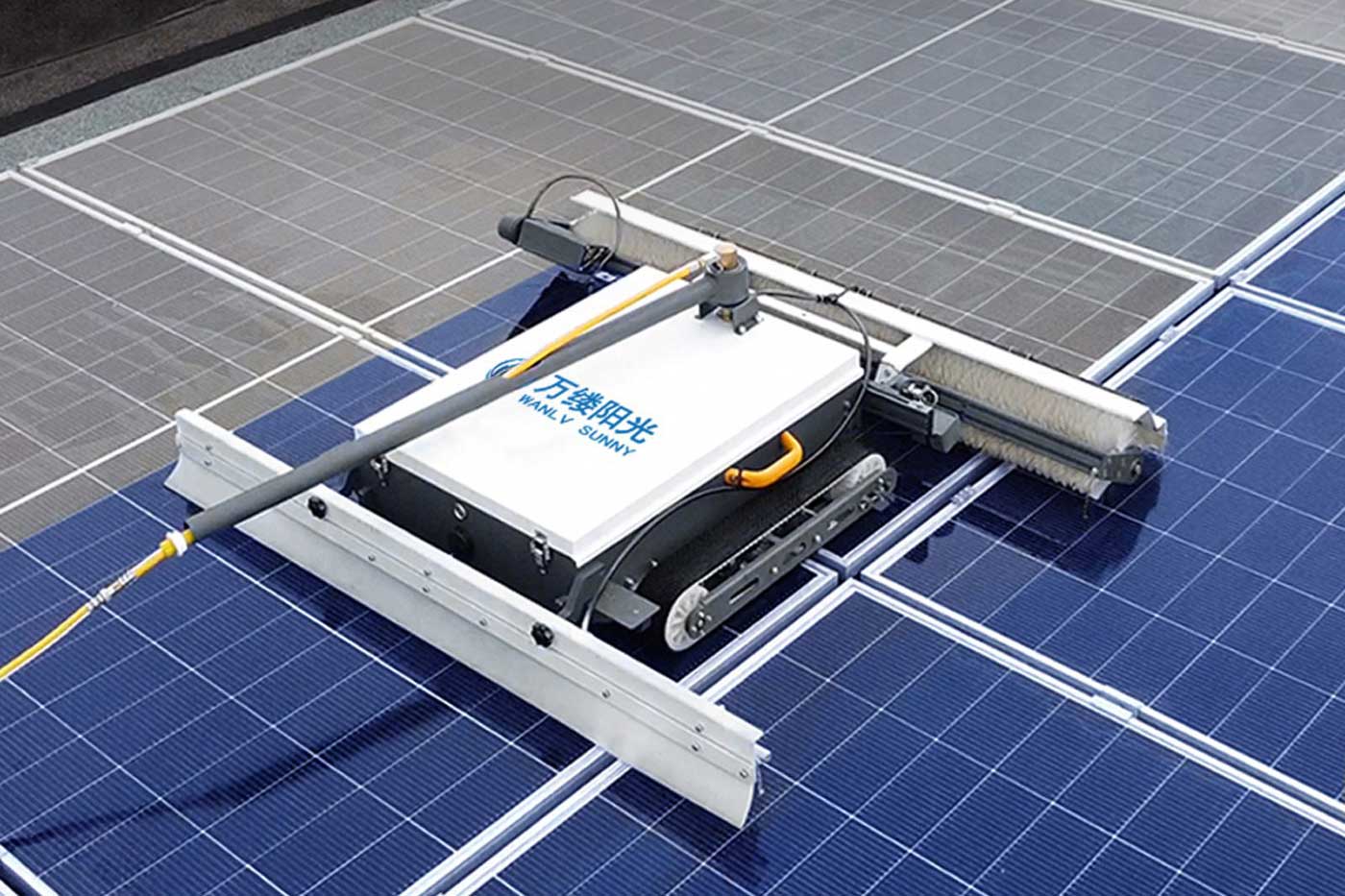
WLS-7PRO Tracked Solar Panel Cleaning Robot
The Ultimate Solution for Utility-Scale Efficiency and ROI Optimization
In the Gulf, one dusty week is enough to cost a utility-scale plant one to two percent of its yield — and a full season without cleaning can push soiling losses past five percent. The WLS-7PRO is built for that reality: a remote-controlled, tracked solar panel cleaning robot that runs dry or wet, holds 20° array tilt, and covers up to 12,000 m² of glass per shift with the operator standing safely on the ground.
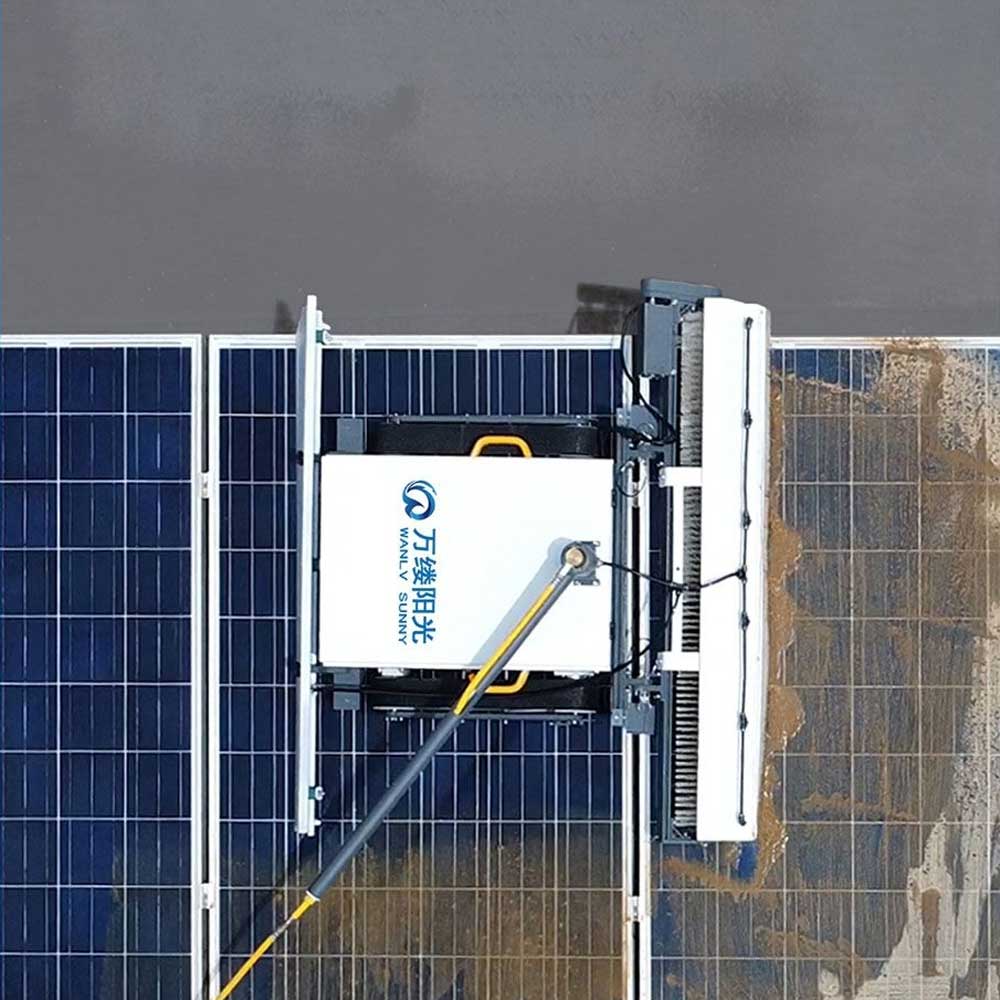
Built for 50 °C Afternoons and Abrasive Grit
Heat and grit are the two things that kill cleaning equipment in the Middle East. The WLS-7PRO is engineered around both.
Put a number on your soiling loss
Soiling is not weather — it is a measurable line item. Take your plant’s annual generation, multiply it by your current soiling loss, then by your PPA or feed-in tariff. On a 100 MWp plant, every 1% of soiling equals roughly 1.5–2 GWh a year. If a robot plus one operator per shift costs less than that number, the decision is arithmetic, not opinion. Most O&M teams in Saudi Arabia, the UAE and Oman land on a cleaning interval of 10 to 20 days during the dusty season — the WLS-7PRO is sized for exactly that cadence.
Engineered for sustained heat
- Sealed drivetrain: travel motors and control electronics sealed against fine dust for continuous desert deployment.
- All-day endurance: lithium battery rated for 4–5 hours of continuous operation, with an 8–10 hour long-range version for double shifts. An 8-hour charge cycle fits overnight charging.
- Consumable brush, not a fixed part: bristle stiffness is selected per site — softer nylon for anti-reflective coated glass, stiffer filament for cemented sand. Replacement rollers ship as a separate line item, so a plant can hold spares without buying a second machine.
Key Performance Pillars
1. 12,000 m² per Shift, with No Blind Spots
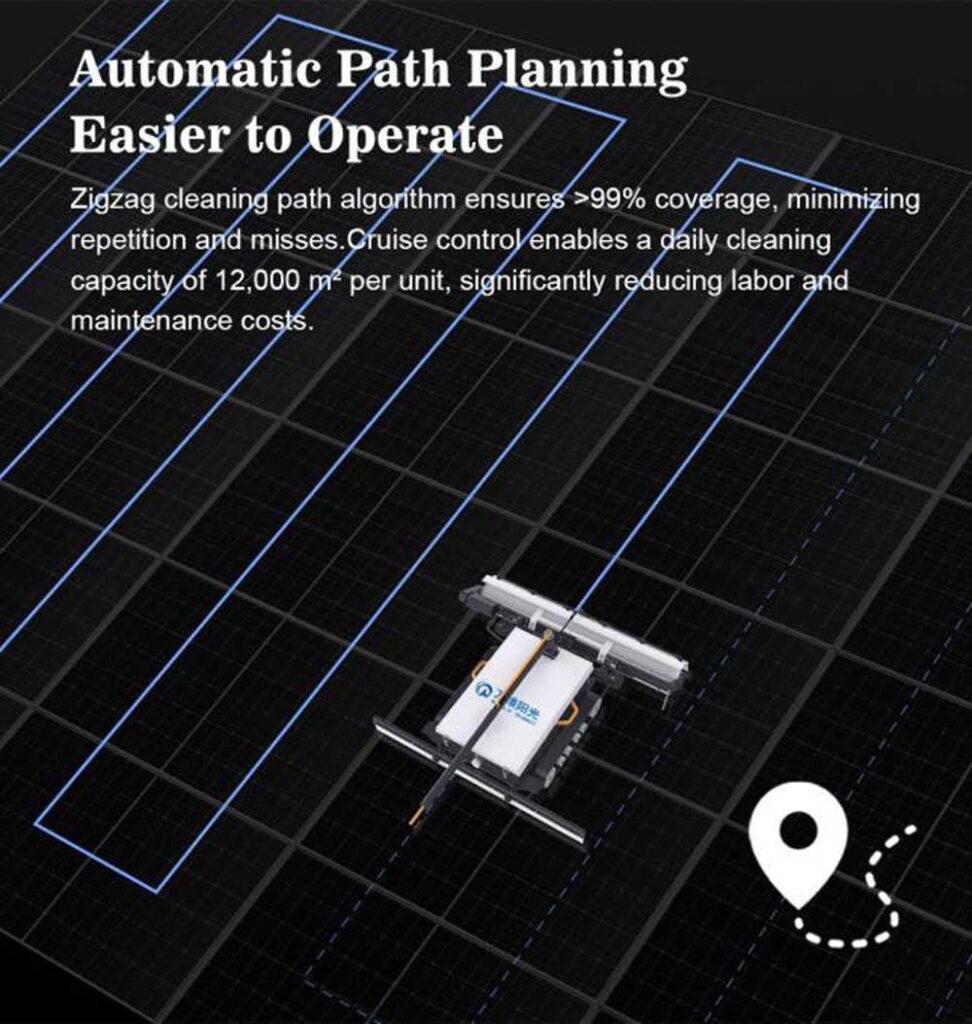
- Total coverage: our proprietary zigzag path-planning routine ensures more than 99% surface coverage, eliminating the missed strips along frame edges and row ends — the exact places where dust accumulates first and hot spots form.
- Cruise control: set your parameters and let the robot work. A single unit maintains a cleaning capacity of up to 12,000 m² of glass per day, with one operator on the ground.
- Self-correcting steering: if the robot encounters an unexpected skid or offset on a wet or dusty surface, the system corrects the vehicle body within seconds to stay on path.
2. Adaptive Speed & Dual-Mode Cleaning
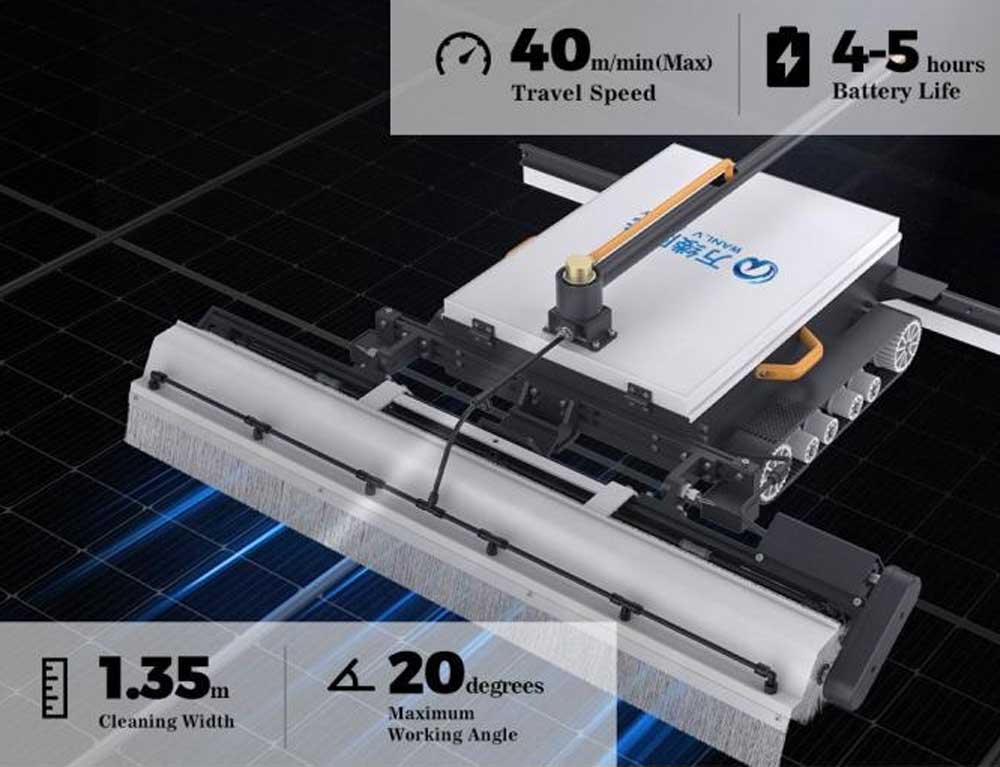
- Three speed settings: 20, 30 and 40 m/min. Run 20 m/min to deep-clean bird droppings and cemented dust after a sandstorm; run 40 m/min for routine light-dust maintenance.
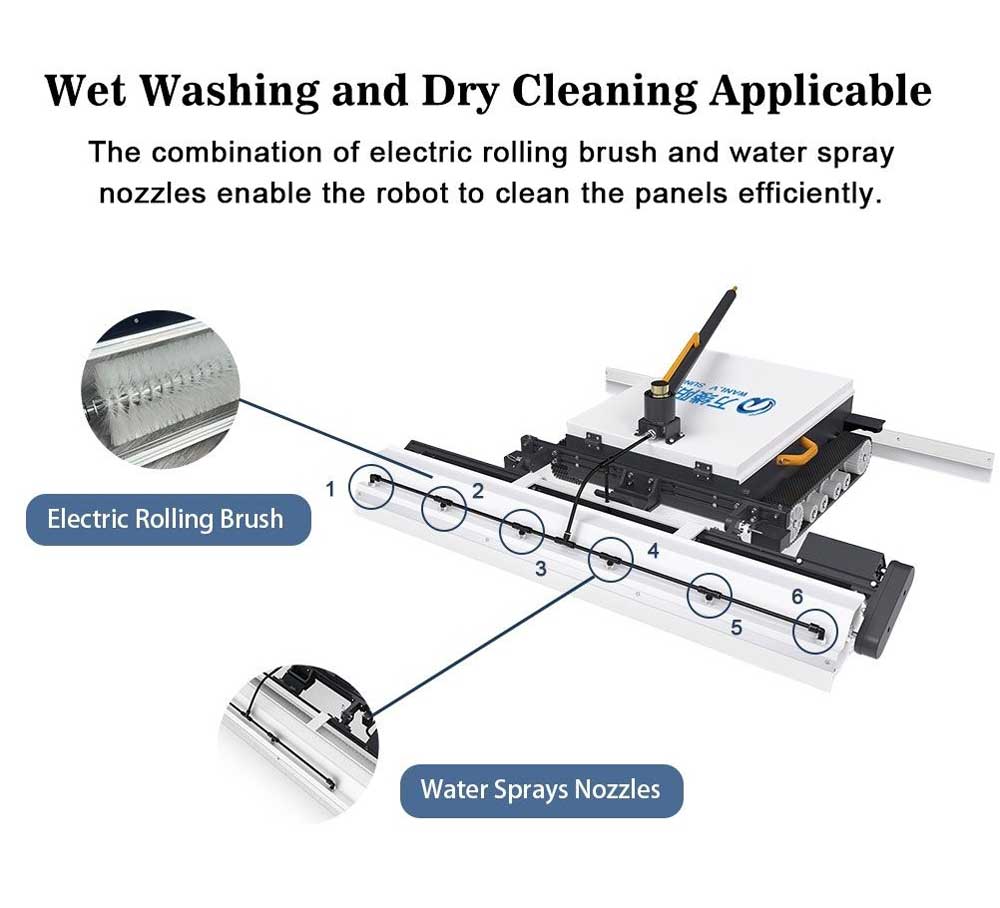
- Dry cleaning where water costs more than electricity: the electric rolling brush and dirty-water scraper remove dust, sand and agricultural residue without a single litre — the standard mode for inland desert sites delivered by tanker.
- Wet mode when the job needs it: for grease, cement kiln dust or bird lime, switch on the low-pressure spray nozzles. The scraper leaves the glass streak-free, so no rework shift is needed.
- Long endurance: 4–5 hours of continuous operation on the internal lithium battery, with an optional 8–10 hour long-life version.
3. Safety-First Engineering
- Anti-drop protection: built-in ultrasonic sensors detect the edge of the photovoltaic panels. If no panel is detected beneath the chassis, the robot triggers a stop-and-return command automatically.
- Fail-safe braking: in the event of power loss, travel motors lock within 0.5 seconds to prevent the machine from rolling or falling.
- Steep slope stability: anti-slip caterpillar tracks are designed for high-grip performance, supporting working angles up to 20°, with derated configurations for 15° and 10° mounting structures.
- Ground-level operation: the operator manages the robot from a wireless remote control — no one stands on the array.
Product Structure & Details
| Component | Functionality |
| Electric rolling brush | High-speed rotation for dry cleaning or wet scrubbing; bristle stiffness matched to the site. |
| High-pressure water nozzles | Precisely angled sprayers to loosen stubborn dirt in wet mode. |
| Dirty water scraper | Leaves the panels streak-free and ready for maximum sunlight absorption. |
| Wireless remote control | Allows operators to manage the robot from a safe distance on the ground, reducing physical labor. |
Technical Parameters
| Parameter | Value |
| Cleaning width | 1,400 mm |
| Travel speed | 20 / 30 / 40 m/min (max, ±2 m/min) |
| Suitable PV tilt angle | L 20° / M 15° / H 10° |
| Run time | 4–5 h (standard) / 8–10 h (long-range) |
| Charging time | 8 h |
| Dimensions (L×W×H) | 1,550 × 1,150 × 350 mm |
| Chassis weight | 30 kg |
| Working weight (chassis + brush + battery) | approx. 49 kg |
| Brush weight | 11 kg |
| Battery weight | 8 kg |
| Horizontal reach | 25 cm |
| Cleaning mode | Dry brush / wet spray with scraper |
Which Plants Does the WLS-7PRO Serve?
- Utility-scale ground-mount: fixed-tilt blocks cleaned on a 10–15 day cycle. At 12,000 m² per shift, two units cover a 50 MWp plant with margin for weather downtime.
- C&I and rooftop arrays: the 30 kg chassis is man-portable between rows and fits standard roof hatches and service lifts, where telescopic poles cannot reach.
- Tracker arrays: the unit is specified for fixed-tilt structures at 10°, 15° and 20°. For single-axis trackers, the array is moved to a stow position before cleaning — contact us for the recommended procedure.
- Coastal and agrivoltaic sites: dry brushing handles salt spray, pollen and crop residue without runoff onto crops or soil.
Send us your module dimensions, row length and tilt, and we will return a modeled cleaning schedule with the unit count for your plant.
Global Logistics & Packaging
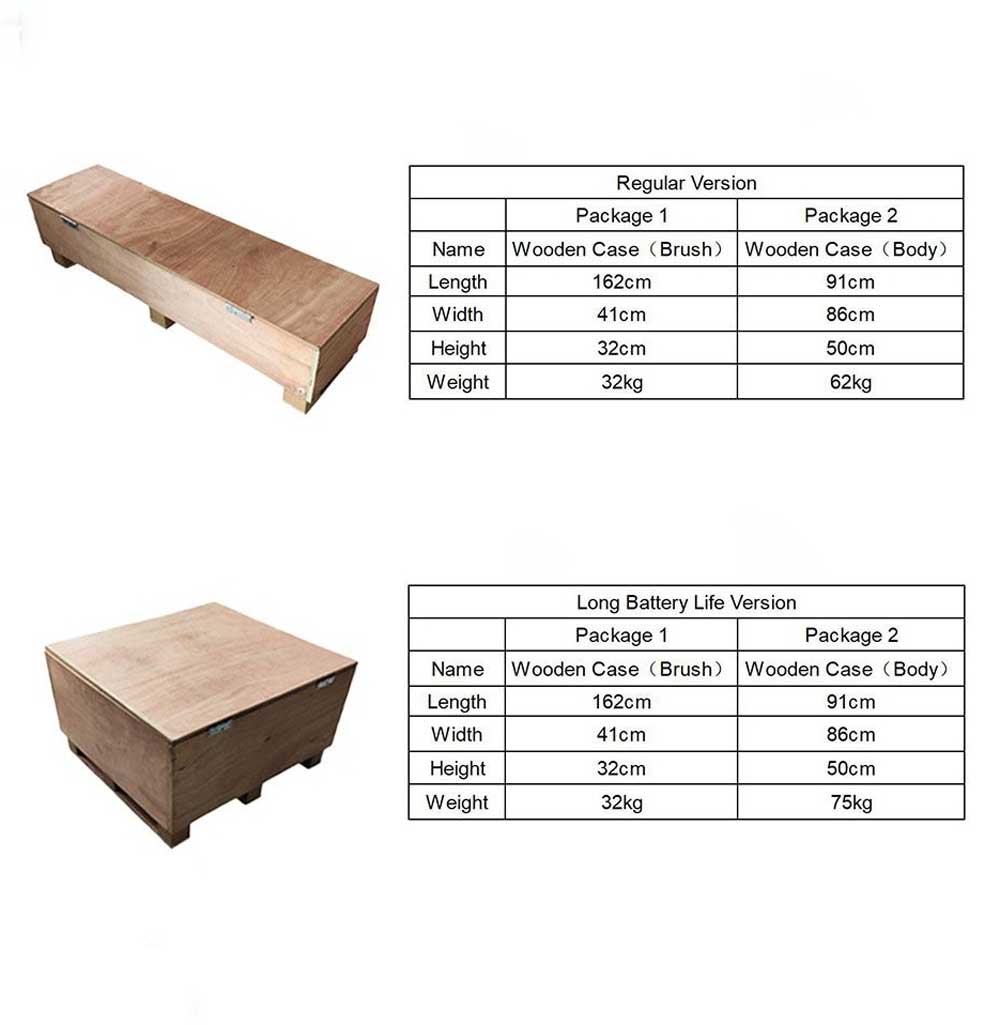
Each unit ships in two reinforced wooden cases to arrive in perfect condition:
- Package 1 (Brush): 162 × 41 × 32 cm
- Package 2 (Body): 91 × 86 × 50 cm
- Total shipping weight: approx. 94–107 kg depending on battery version
Two units fit a standard 20 ft container together with accessories and spares. Confirm the loading plan with our export team at order stage.
Configurations & OEM Support
- Standard (SR): 4–5 h battery, one shift per charge — best suited to plants under 20 MWp.
- Long-range (LR): 8–10 h battery, two shifts per charge — best suited to utility blocks cleaned on a fixed 10–15 day cycle.
- Water package: high-pressure pump, 100 m hose and reel for sites running wet cleaning.
We manufacture in Wuxi, China and supply EPC contractors, O&M providers and regional distributors worldwide. For distributors we offer private-label branding on the body and controller, localized manuals, and a spares kit sized to your installed base. MOQ and lead time are quoted per configuration — send your plant profile and we will return a unit count and cleaning schedule.
Frequently Asked Questions (FAQ)
Q: Can it be used for dry cleaning?
A: Yes. The combination of the electric rolling brush and high-torque motors allows efficient dry cleaning in arid regions where water is scarce.
Q: Is it safe for the panels?
A: Yes. The 30 kg chassis (approx. 49 kg in full working configuration with brush and battery) distributes load through the tracked chassis, so no point loading or micro-cracks occur on the PV glass.
Q: How many units do I need for a 50 MWp plant?
A: A 50 MWp plant typically holds 80,000–95,000 m² of glass. At 12,000 m² per shift and a 12-day cleaning cycle, two units cover the plant with margin for weather downtime. Send us your module dimensions and row layout and we will model it precisely.
Q: Can it handle tracker arrays?
A: The unit is specified for fixed-tilt structures at 10°, 15° and 20°. For single-axis trackers, the array must be moved to a stow position before cleaning; contact us for the procedure.
Q: What is the operating temperature limit?
A: The unit is deployed on Gulf sites through summer. Sustained ambient above 45 °C reduces usable battery run time, so we recommend scheduling shifts for early morning during June to August.
Q: How long does a brush last, and what is the warranty?
A: On abrasive desert dust, expect 800–1,200 operating hours per roller; sites running daily cleaning should hold one spare roller per unit. Warranty covers drive motors, lithium battery and charger for 12 months, and electronic components for 6 months.