Ask three suppliers for a solar panel cleaning brush and you will usually get three polymer names — nylon, PP, sometimes PBT — with very little explanation of why. On a quotation sheet the brushes look identical: white filament, aluminium pole, one roller head. On glass they behave nothing alike, and the difference surfaces two or three seasons later as haze, fine scratches and modules that no longer deliver their nameplate output.
This guide compares nylon and polypropylene bristles for solar panel cleaning, on the application where the choice is least forgiving: anti-reflective (AR) coated glass. We will look at what each polymer does under load, where each belongs, and how to qualify a brush before you commit to a container load.
Why Bristle Material Is a Coating Decision
A brush roller is a simple machine: a tube, a tuft pattern and tens of thousands of filaments. The pole, the motor, the battery and the hose can all be repaired. The coating on the module cannot. Once the AR layer is abraded there is no field fix, no polishing step and no warranty remedy that restores it.
The failure is invisible at first
Coating wear rarely announces itself. A brush that is slightly too aggressive leaves a dull, uniform micro-scuff pattern you only see under grazing light or on a haze meter, so it gets blamed on soiling, on the site, on the weather — never on the brush. A fraction of a percentage point of transmission lost per module is trivial on one panel and significant across tens of thousands of them, every day, for the life of the plant.
Nylon (PA6 and PA66): The Engineering Default
Nylon is the standard filament for brushes working against a delicate surface at speed. It is not chosen because it is soft — it is chosen because it recovers.
Abrasion resistance and tip recovery
Polyamide filaments have high toughness and strong elastic recovery, so a filament bent against the glass springs back to straight instead of staying deformed. That keeps contact pressure even across the full working width. When filaments keep their shape, every tuft shares the load; when they do not, a few stiff tufts take all of it and press into the coating.
Heat tolerance at brush speed
Two temperatures matter. Unfilled PA6 melts around 220 °C and PA66 around 255 °C, while polypropylene homopolymer melts near 160–170 °C and softens well below that. Separately, module surfaces in Gulf or Australian summer conditions can sit above 60 °C while crews are still working. Put a filament near its softening range into a roller turning at 680 r/min — the motor speed on our WLS-5 head — and it flexes tens of thousands of times an hour against warm glass. Polymers near their softening point creep: tips flatten, filaments take a permanent bend, cleaning force drops exactly where you need it.
Water uptake and chemistry
Nylon absorbs moisture — roughly 2–2.5% by weight for PA6 at moderate humidity, less for PA66 — where PP absorbs almost nothing. For panel brushes this is a secondary effect: absorbed moisture plasticises the filament slightly, making a wet nylon brush marginally gentler on the coating. It does demand disciplined filament quality and solid tuft anchoring, because a wet filament is not quite the filament that was crimped dry.
Nylon handles neutral detergents and normal site water without difficulty. It is attacked by strong acids and, over time, by concentrated hypochlorite — so if a site uses hypochlorite against biofilm, confirm compatibility and rinse rollers after each shift rather than leaving them soaked.
Polypropylene: Cheap, Stiff, Usually the Wrong Answer Here
Where PP earns its place
Polypropylene is a good engineering material: chemically inert against almost everything a wash crew uses, effectively zero water absorption, and a fraction of the cost of nylon. For tank brushes, high-pH wash lines and general sweeping, it is often the correct choice.
Where it fails on glass
The weakness is fatigue. Under repeated bending, PP takes a permanent set — filaments flatten at the tip and stay flattened. On a roller that produces flat spots: the remaining tufts carry a higher point load while the flattened ones polish the glass with a stiff edge instead of a flexible tip. Combine that with lower abrasion resistance and the tips fray rather than wear evenly, and a frayed tip is a grit trap.
PP also charges readily in dry air. Dust lifted by the brush can re-attach to the glass behind the roller, showing up as streaks and a haze that returns within minutes. Nylon is less prone, but no polymer solves it; the answer is a water film carrying soil away, which is why brush material and water delivery must be specified together.
Nylon vs PP: Side-by-Side for Solar Panel Brushes
| Property | Nylon (PA6 / PA66) | Polypropylene (PP) |
|---|---|---|
| Abrasion resistance | High — tips wear smooth, slowly | Lower — tips fray and trap grit |
| Recovery after bending | Good — returns to straight | Poor — takes a permanent set, flat spots |
| Heat tolerance | Melts ~220 °C (PA6) / ~255 °C (PA66) | Melts ~160–170 °C, softens earlier |
| Water absorption | ~2–2.5% (PA6), lower for PA66 | Below 0.1% |
| Chemical resistance | Good with neutral detergent; weak against strong acids and hypochlorite | Excellent across acids, alkalis and detergents |
| Static build-up | Moderate | High — dust re-deposits behind the roller |
| Cost per roller | Higher | Lower |
| Best fit | AR-coated glass, high cycle counts, motorised rollers | Chemical wash lines, tanks, low-cost manual sweeping |
Melting points and water uptake are typical published ranges for unfilled PA6, PA66 and PP homopolymer. Commercial brush filament is compounded with UV stabilisers, so a specific grade will differ slightly. These ratings describe general material behaviour, not one supplier’s test data.
The AR-Coating Factor Most Comparisons Miss
An anti-reflective coating is a porous silica film measured in nanometres. It is softer than the tempered glass beneath it and more chemically reactive, so abrasion that would only polish bare glass can erode the AR layer — and high-pH chemistry left to dwell on a warm module attacks the film with no mechanical action at all.
Three things that scratch coated glass
- Dry brushing. Dust and quartz grit under a moving filament is sandpaper. The brush should arrive on a wetted surface.
- Dried mud and carbonate. Baked-on droppings and cement dust do not lift with light contact; operators press harder, and pressure — not the polymer — does the damage.
- Edge loading. Roller ends and frame corners concentrate force, loading a narrow band of glass far above average pressure.
Safe does not mean soft. A nylon filament of the right diameter with a rounded tip, moving under a steady water film, cleans better and lasts longer than a softer brush pressed hard. Contact pressure, grit control and tip geometry decide coating safety; the polymer only sets the ceiling for all three.
Filament diameter, density and tip finish
Panel brush filament usually sits between 0.3 mm and 0.8 mm. Thinner filament is gentler and reaches into frame edges but struggles with baked-on deposits; thicker filament cleans aggressively and raises point load at the tips. On AR-coated glass the trend is toward finer, more flexible filament with more passes, not coarser filament with fewer. Density controls how evenly load is spread and how much water the roller carries. Tip finish matters just as much: a cut filament ends in a sharp square edge, while a rounded or flagged tip presents a soft surface to the coating — one of the cheapest upgrades on a brush order, and the most frequently skipped when quotes are compared on price alone.
How to Qualify a Brush Before You Buy a Container Load
- Get the right glass. Use a broken or rejected module of the same make and coating as the site; window glass tells you nothing.
- Run a realistic cycle count. Wet and dry passes at the pressure your crew actually applies, not a laboratory setting.
- Measure haze, not opinion. A haze meter reading before and after, following ASTM D1003, turns “it looks fine” into a number you can hold a supplier to.
- Inspect tips under magnification. Look for flattening, fusing, fraying and embedded grit, comparing used against new.
- Weigh the rollers. Filament mass loss is the simplest objective wear measure and predicts replacement intervals better than visual inspection.
If a supplier cannot state the polymer grade, the filament diameter and the tip finish, the quotation is not yet a specification. Our own solar panel cleaning brush roller replacement guide covers what to measure once rollers are in service, including the wear patterns that point to the wrong material rather than a worn one.
What WANLV SUNNY Specifies on the WLS-5
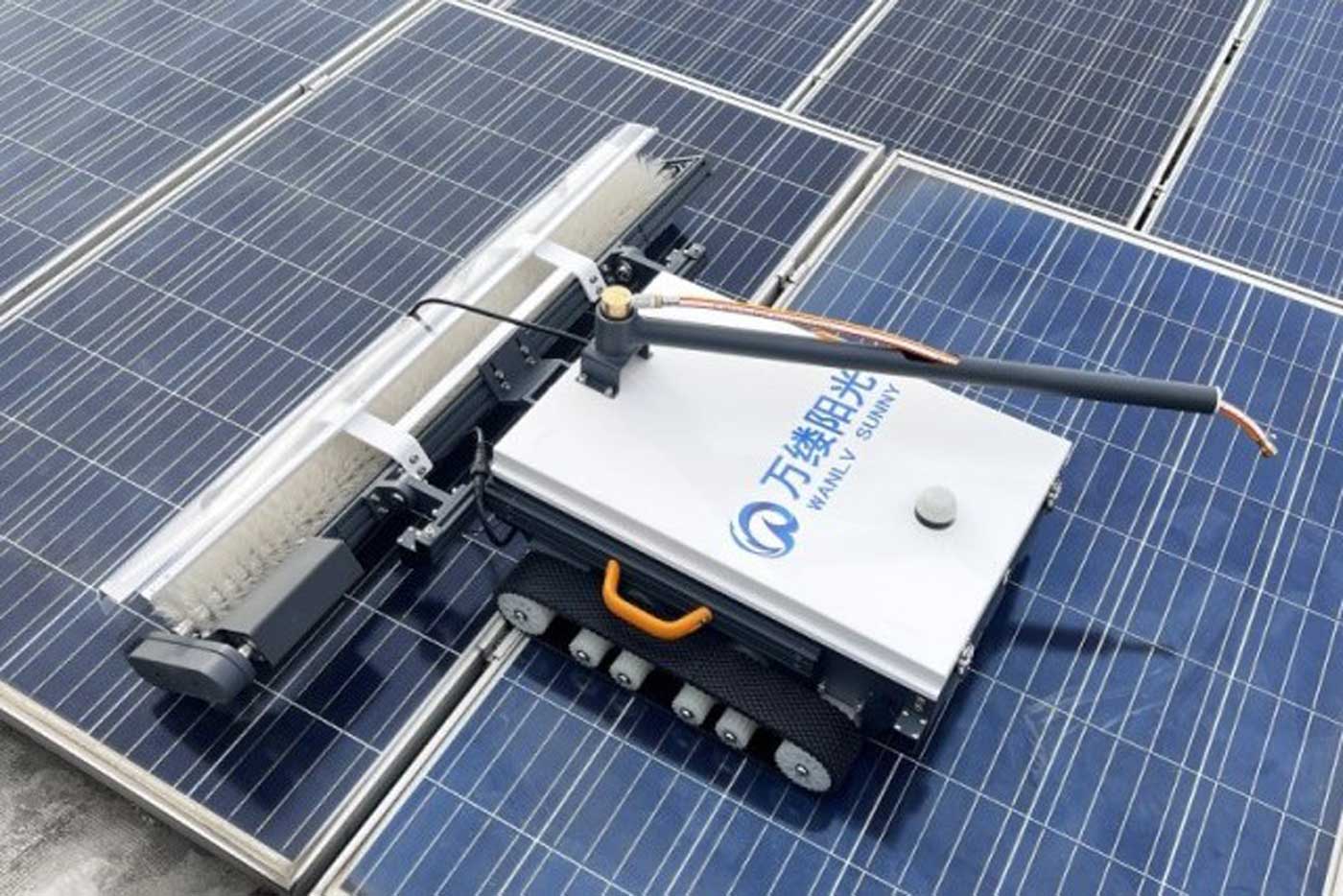
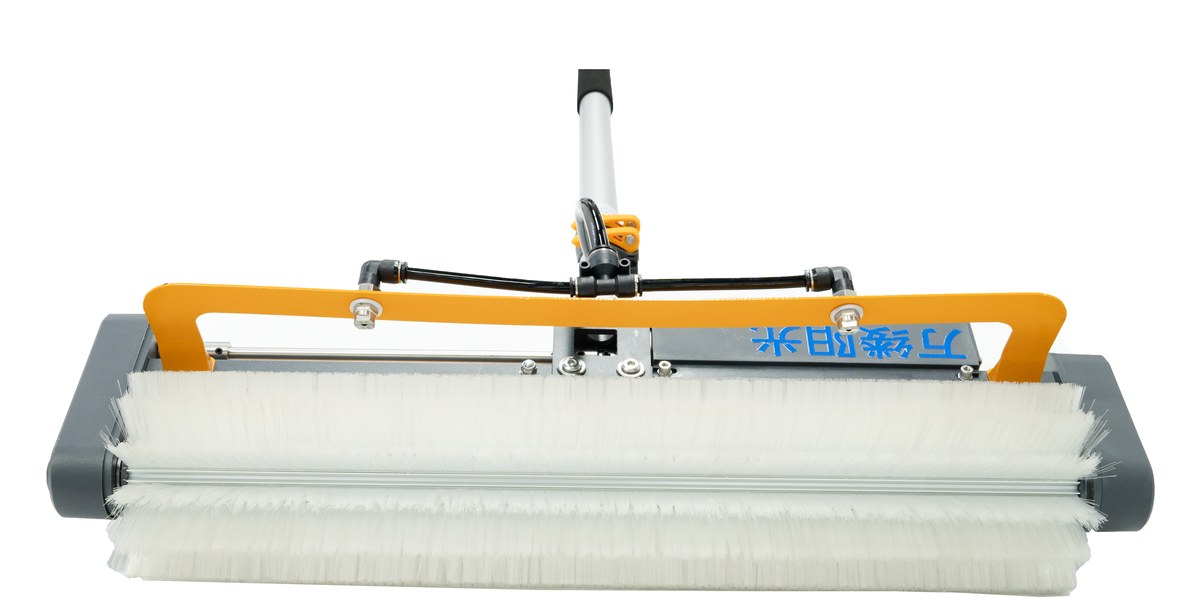
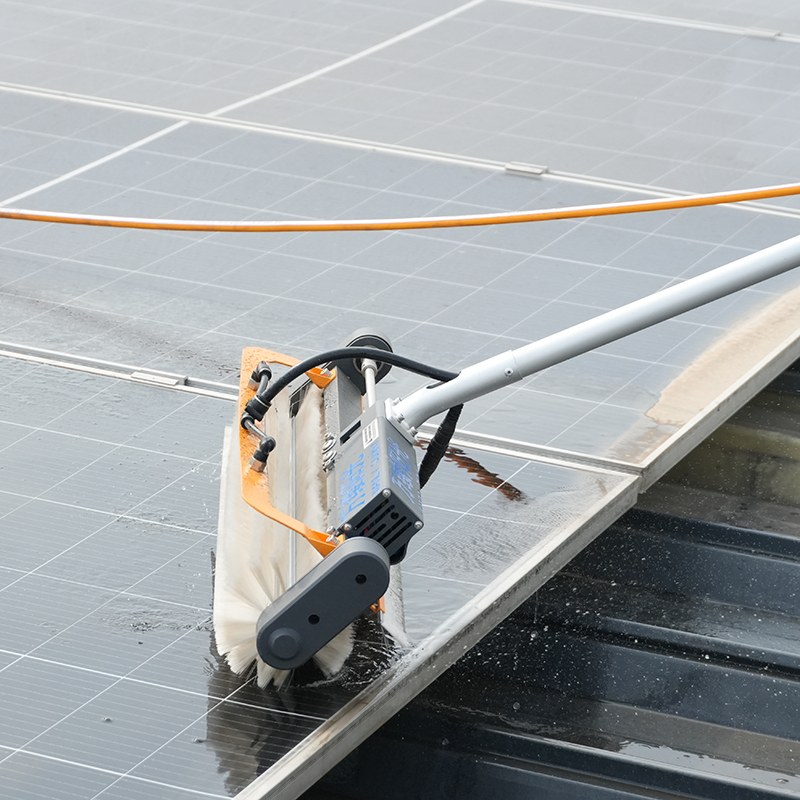
The WLS-5 rolling-brush solar panel cleaning machine uses a single 60 cm nylon-filament roller driven at 680 r/min, with wet and dry capability and a 24 V supply across its plug-in, lithium-battery and dual-power versions. That single-roller layout matters for coating safety: the rotating filament lifts soil under a water film instead of grinding it into the coating, so the operator does not have to press the head hard against the glass.
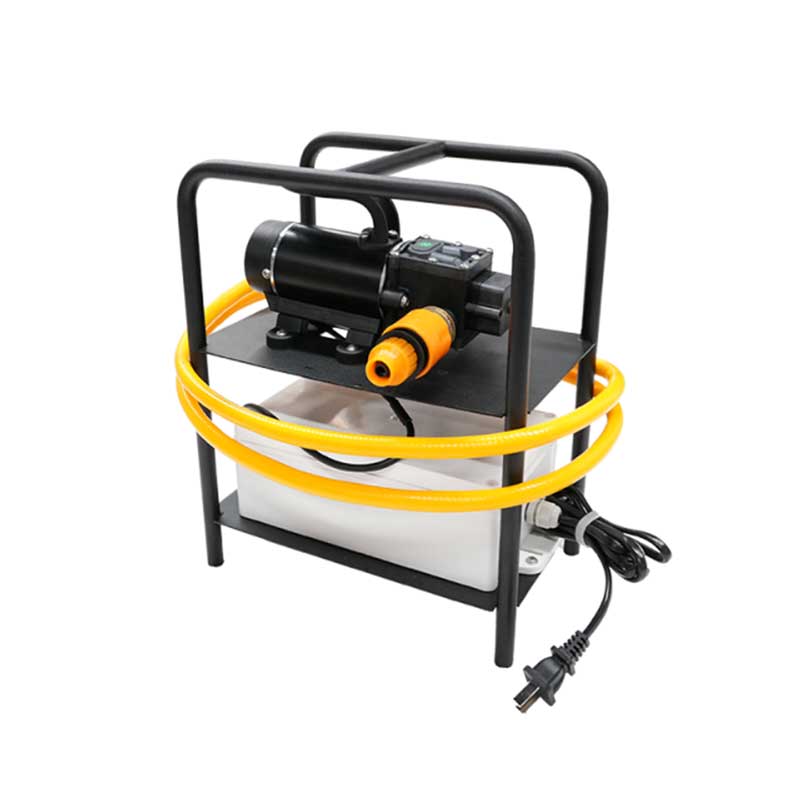
The same logic runs across our range of solar panel cleaning brushes. Teams running long hose runs should also read how to choose a water pump for solar panel cleaning — a starved brush drags grit across the glass no matter which polymer the filament is made from.
Maintenance Habits That Protect the Coating
- Rinse the roller head at the end of every shift. Silt and cement dust at the filament roots turn the brush into sandpaper on the next job.
- Inspect tips weekly and replace on condition. Flattened or frayed tips should not be “run out” for another month.
- Never store a roller under load. A brush left compressed against a frame takes a set exactly where it matters.
- Match the detergent to the coating. Neutral pH, correct dilution, clean-water rinse. High-pH chemistry and AR layers are a bad combination.
The Bottom Line
For AR-coated glass, nylon is the material that keeps its shape, spreads the load and wears smooth instead of fraying. Polypropylene is cheaper and chemically tougher and belongs in tanks and wash lines, but as a roller filament on coated modules it trades a small saving today for haze later. Specify the grade, the diameter and the tip finish, qualify on real glass, then buy.
Send Wuxi Wanlv Intelligent Technology Co., Ltd. (WANLV SUNNY) your module type, coating, cleaning frequency and crew setup — we will confirm the right filament specification and roller configuration within 8 working hours.
Talk to the WANLV SUNNY Team
WANLV SUNNY is a solar panel cleaning equipment manufacturer based in Wuxi, Jiangsu, China. We build tracked cleaning robots, water-fed brush systems, fixed cleaning installations and the rollers, pumps and batteries that keep them running — with 30+ patents and machines in service across utility-scale, rooftop and floating solar plants worldwide.
Wuxi Wanlv Intelligent Technology Co., Ltd.
Rm 507-508, No. 999 Gaolang Road, Binhu District, Wuxi, Jiangsu, China
Vicky — vicky@wanlvsunny.com
Ziggy — ziggy@wanlvsunny.com
WhatsApp: +86 181 1576 1000 / +86 181 5152 7178
Quotes, drawings and roller recommendations within 8 working hours, Monday to Saturday.