Choosing a solar panel cleaning robot is rarely a question of which machine has the highest spec sheet. It is a question of which architecture fits the way your array is built, how often it gets dirty, how much water you can bring to site, and who is going to operate the machine at six in the morning. A tracked crawler that is ideal for a 50 MW ground-mount plant in a dusty region can be the wrong purchase for a rooftop portfolio with 40 different roof heights. A fixed rail system can be the only workable answer on a single large tracker row, and a hand-held brush is still the most economical tool on a 200 kW commercial roof.
This guide sorts the main types of solar cleaning robots – tracked, ground-mobile straddle, fixed or rail-mounted, aerial and hand-held – explains the trade-offs behind each one, and gives O&M teams a shortlist method they can apply before requesting a quote. It is written for EPC contractors, asset owners and O&M operators comparing options, not for homeowners.
Why the architecture matters more than the brochure numbers
Most buying mistakes come from comparing two machines on a single number – cleaning width, speed, or daily capacity – without checking the assumptions behind it. A headline figure of “12,000 m² per hour” belongs to a large ground-mobile straddle gantry working along uninterrupted rows; it says nothing about a site with narrow setbacks, cable trays, or rows that change pitch. A 1,000 m²/h crawler may finish a fragmented rooftop faster than a much bigger unit, simply because it can be carried between blocks by two people.
Before looking at any spec, write down four site facts: array geometry (row length, pitch, tilt, gaps), surface sensitivity (anti-reflective coating, glass type, warranty language), utilities (water availability, pressure, drainage, power for charging), and labour reality (crew size, shift window, access rules). Those four facts eliminate roughly half the market before a single quotation is needed.
The five equipment families in commercial PV cleaning
Suppliers use overlapping names – “robot”, “automatic cleaning machine”, “cleaning system” – which makes comparison harder than it needs to be. Grouping by how the machine is supported and moves relative to the module row is more useful:
- Tracked / crawler robots – self-propelled units with rubber or metal tracks that drive along the module row, carrying a rotating brush and optional water spray.
- Ground-mobile straddle / gantry machines – a large wheeled frame that runs on the ground on both sides of the module row and straddles it, carrying a long transverse roller brush set to the correct distance from the glass.
- Fixed and rail-mounted systems – a brush carriage travels on rails or a permanent structure installed along the row; the machine stays on site.
- Aerial and drone-assisted systems – a flying platform with a spray or brush head, used where ground access is poor or rows are very long.
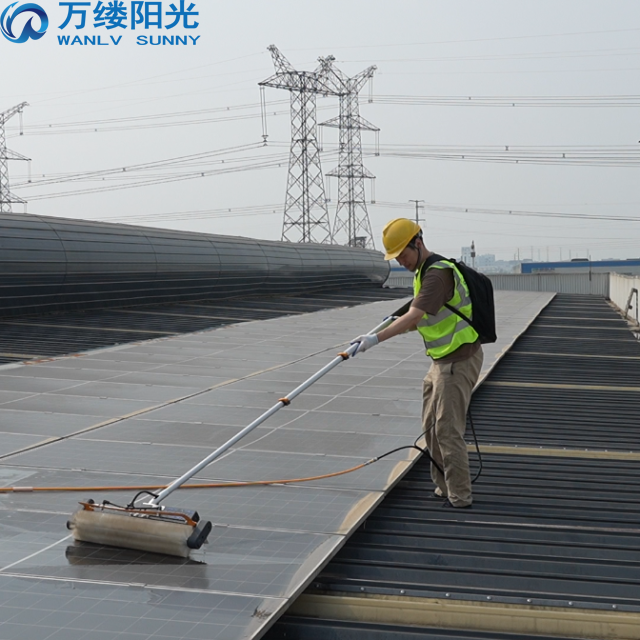
- Hand-held and telescopic brush machines – operator-guided tools with powered rotating heads, from short poles to 11 m telescopic poles.
These are not substitutes. Most large portfolios use two or three of them in different parts of the same asset.
Tracked and crawler robots: the flexible default
A tracked robot is the most common choice for ground-mount utility plants because it needs no permanent installation. It drives onto the row, cleans with a rotating nylon brush, and is moved to the next row by the crew or by remote control. There is no rail to engineer, no civil works, and no permanent structure to certify against the module warranty.
Within our own range, the WLS-7 cleaning robot is the general-purpose ground-plant unit: dual 24 V lithium batteries giving about five hours of operation, a 1,200 mm nylon brush, both dry and wet cleaning, a travel speed of 22 m/min and remote control. Its rated capacity is 1.2 MW per day, which makes it a practical fit for plants where the cleaning window is a single shift. The WLS-7PRO tracked photovoltaic cleaning robot adds a 1.35 m cleaning width and a 48 V / 31 Ah battery for operators who want fewer passes per row.
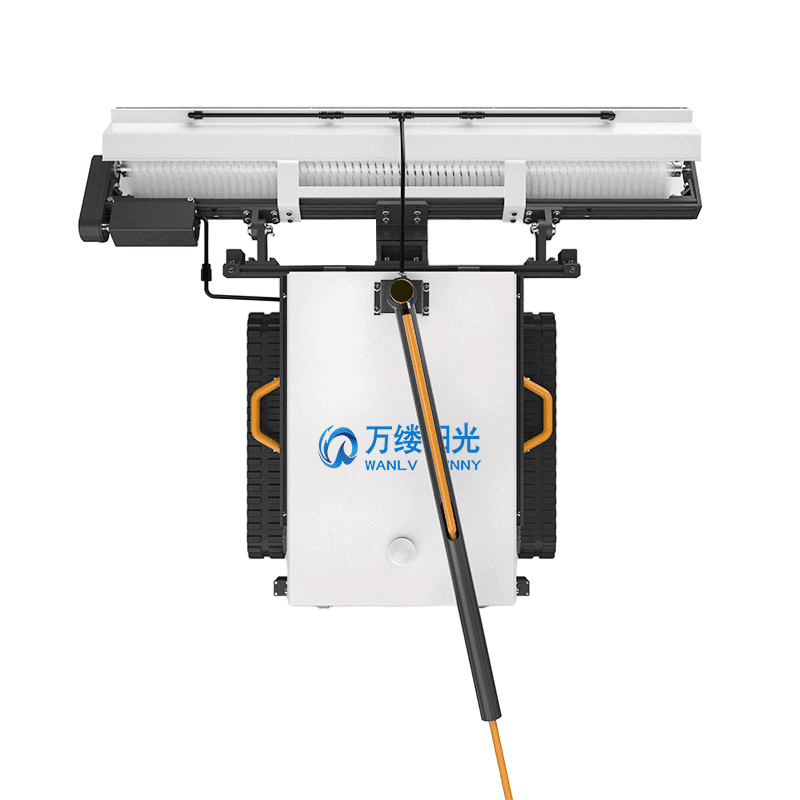
At the other end of the size scale, the WLS-73S crawler robot weighs 34 kg and can be lifted by two people, carries a 1,200 mm brush and a swappable 25.2 V battery with around four hours of runtime, and covers roughly 1,000 m²/h with a 150 m remote range. That portability matters on flat commercial rooftops where a full-size machine cannot be moved between roof sections without a crane.
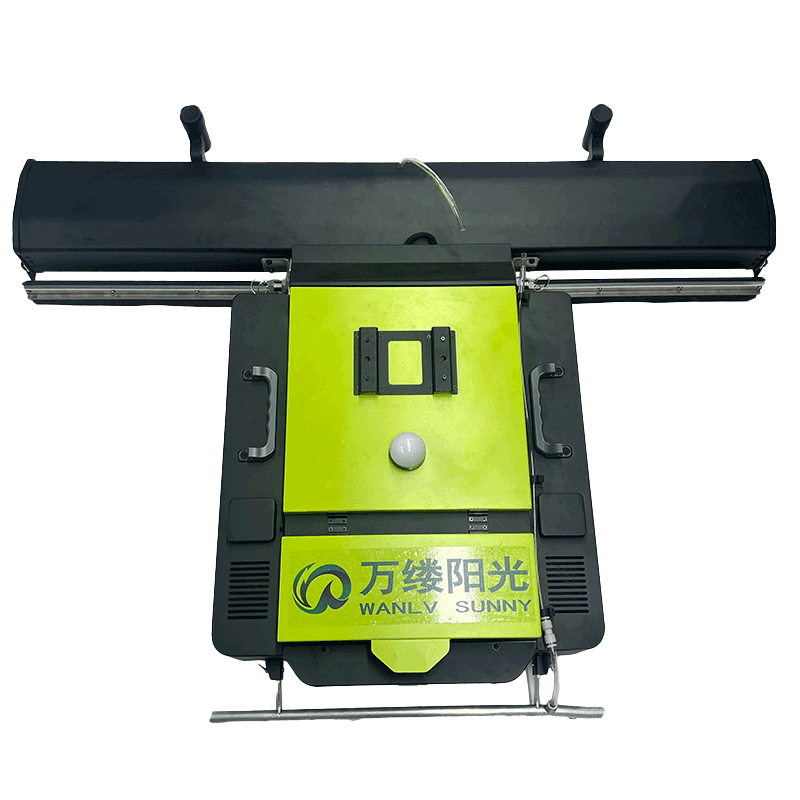
The trade-off with any tracked machine is that a person still has to place it on the row, and that cleaning quality depends on the brush staying in even contact with the glass across the whole pass. On a tracker row that changes tilt through the day, the operator may need to work within a specific tilt window.
Ground-mobile straddle machines: a different architecture, not a bigger WLS-7
The WLS-7-LM ground-mobile straddle cleaning machine is sometimes mistaken for a larger version of the WLS-7 because of the similar model number. It is not. This is a large wheeled gantry: its frame runs on the ground on both sides of the module row and straddles the panels, with a long transverse roller brush lowered to the correct working distance from the glass as the machine moves along the row. Nothing rides on the modules themselves. That is a different movement architecture, a different installation, and a different class of site – long, uniform ground arrays with clear ground access down both sides.
Its rating belongs to that architecture alone: a 51.2 V / 300 Ah LiFePO4 pack, a 5.5 kW generator, 24-hour endurance and a throughput of at least 12,000 m²/h. The WLS-7, by contrast, is a tracked crawler that drives along the module row and is rated at 1.2 MW per day. The two figures are not interchangeable and neither machine is a variant of the other. When a tender asks for a capacity number, ask which architecture it was measured on.
Fixed and rail-mounted systems: high utilisation, high commitment
A fixed installation puts the cleaning hardware on the array permanently. The WLS-8 fixed cleaning robot is our example: it travels more than 3,000 m along its rail at 12 m/min, crosses obstacles up to 30°, is rated IP65, and runs on a 16-40 Ah battery kept charged by a 55-165 W solar panel. Because the hardware is already in position, the marginal cost of an extra cleaning cycle is small – which is exactly what you want in a high-soiling region where modules may need cleaning weekly rather than monthly.
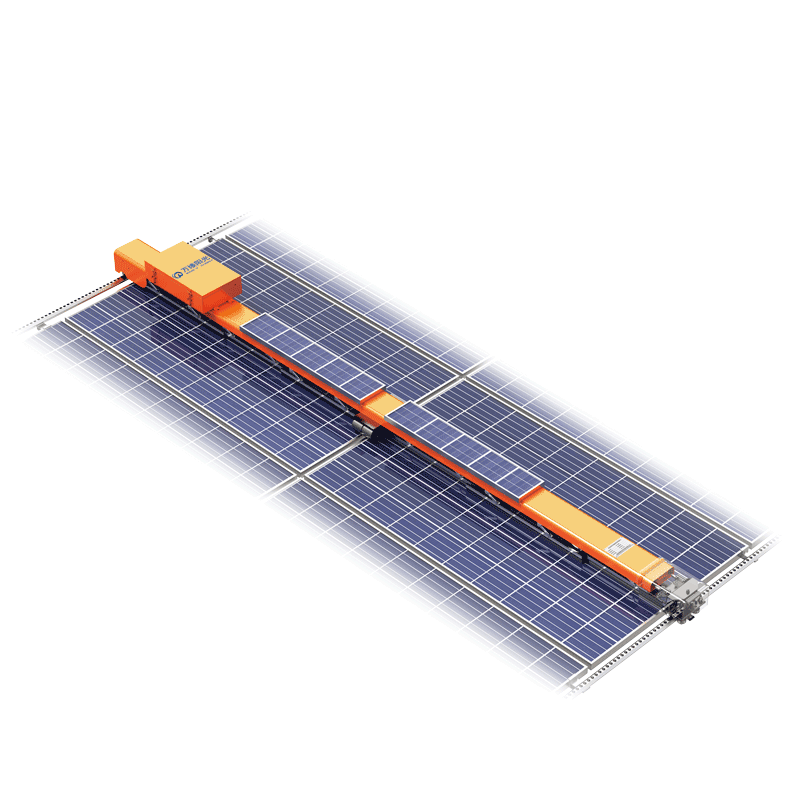
The cost is commitment. Rails have to be engineered to the row, aligned to the module edge, and accepted by the structure and warranty holder. A fixed system is hard to redeploy, and if the plant layout changes it is largely stranded. It suits a single, stable, high-value array with predictable high soiling – not a portfolio of small, mixed sites. This is also the family where “rail-mounted” and “fixed” are used interchangeably in the market; ask the supplier to show the mounting detail rather than relying on the label.
Aerial systems: solving access, not throughput
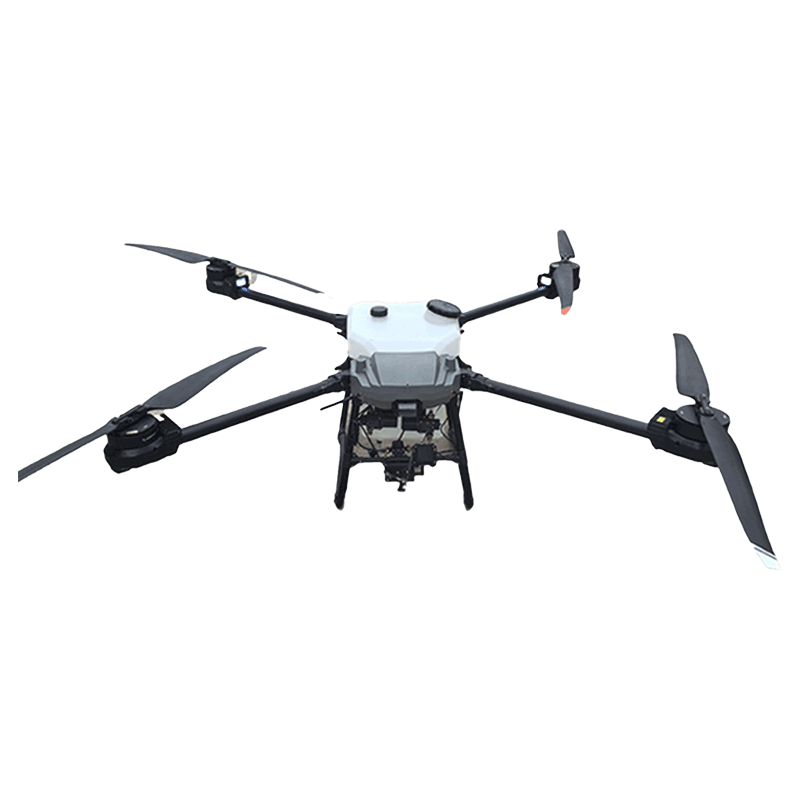
The WLS-9YQ-LD1 cleaning drone uses a carbon-fibre and aviation-aluminium frame rated IP67, a 2,900 PSI pump delivering 14 L/min, and an 80 m hose. It earns its place where access is the binding constraint – steep terrain, elevated rows, water-fed facades, or sites where bringing a tracked machine to each row is slower than flying to it. It is not a replacement for a brush-based crawler on a conventional dusty ground plant: contact pressure and mechanical dust removal are different jobs from a high-pressure spray.
Hand-held and telescopic brushes: still the right answer sometimes
It is worth resisting the assumption that “robot” always means better. A powered brush in an operator’s hands gives immediate visual feedback – the operator can see a bird dropping, a sticky patch or a damaged frame and deal with it in the same pass. For small commercial roofs, irregular arrays, and spot cleaning after a dust event, this is often the cheapest reliable option.
Our brush range is deliberately split by head geometry rather than sold as one machine: the WLS-3 single-head photovoltaic cleaning brush uses one disc head, the WLS-4 double-head photovoltaic cleaning brush two, the WLS-5 single-roller photovoltaic cleaning brush a single 60 cm roller running at 680 r/min on 24 V, and the WLS-2 manual telescopic photovoltaic cleaning brush a carbon-fibre pole reaching up to 11.4 m with a 24 V / 120 W pump. These are different products; a double-head machine and a single rolling brush are not interchangeable in a specification.
Side-by-side comparison
| Family | Best fit | Main advantage | Main constraint |
|---|---|---|---|
| Tracked / crawler (WLS-7, WLS-7PRO, WLS-73S) | Ground-mount plants, flat commercial roofs | No permanent works; redeployable | Crew must position the unit each row |
| Ground-mobile straddle / gantry (WLS-7-LM) | Long uniform ground arrays with access on both sides | Very high throughput; nothing rides on the modules | Large frame; needs long unbroken rows and clear ground logistics |
| Fixed / rail-mounted (WLS-8) | Single stable array, high soiling frequency | Low cost per extra cleaning cycle, solar charging | Permanent engineering and warranty acceptance |
| Aerial (WLS-9YQ-LD1) | Poor ground access, elevated rows | Reaches places a crawler cannot | Spray-based, not a substitute for brush contact |
| Powered hand-held (WLS-2/3/4/5) | Small roofs, spot cleaning, irregular arrays | Operator judgement, lowest capital cost | Labour scales linearly with area |
A seven-question shortlist method
- How long is an uninterrupted row? Short, fragmented rows favour a portable crawler or hand-held brush; very long rows can justify a fixed rail.
- Does the tilt change? Single-axis trackers add a tilt window and a contact-pressure question that not every machine handles.
- How often will you actually clean? Weekly cleaning changes the economics towards fixed systems; twice-yearly cleaning rarely does.
- Is water available at pressure, year-round? If not, shortlist dry-cleaning capability and check the brush material against the coating.
- Who moves the machine, and how many people? A 34 kg unit and a multi-hundred-kilo unit imply completely different crew and lift plans.
- What does the module warranty say about contact and coatings? Get the filament specification in writing before comparing prices.
- What is the real cost per cleaned MW over five years? Include batteries, brush wear, water, crew hours and downtime – not just the purchase price.
Water, bristles and the coating: the parts buyers forget
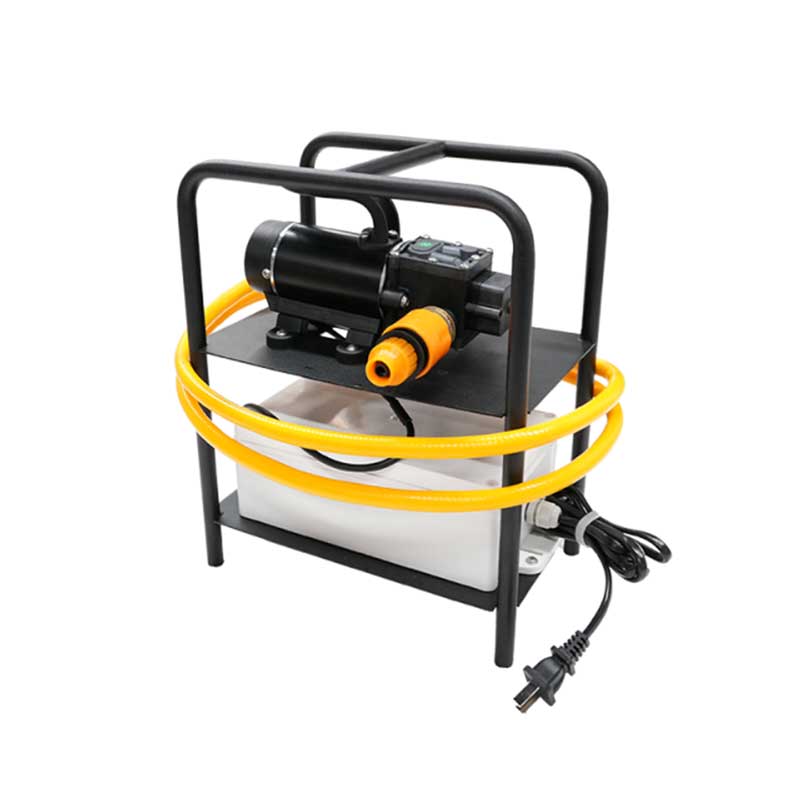
Two specifications decide whether a machine protects or slowly damages a module. The first is the brush filament. Nylon (PA6 / PA66) and polypropylene behave differently on anti-reflective coated glass, and filament diameter and tip finishing matter as much as the polymer name – our nylon vs PP bristle comparison sets out a five-step qualification method. The second is the water system: a steady film lifts grit off the glass instead of grinding it into the surface, and pump pressure has to match the job. Our water pump selection guide covers that calculation, and the brush roller replacement guide shows the wear patterns that indicate the wrong material rather than a worn roller.
Ask any shortlisted supplier for the filament spec sheet, the contact-pressure range, and a written statement of compatibility with your module’s coating. A supplier who can only quote cleaning width is not yet ready for a technical evaluation.
Cost and payback
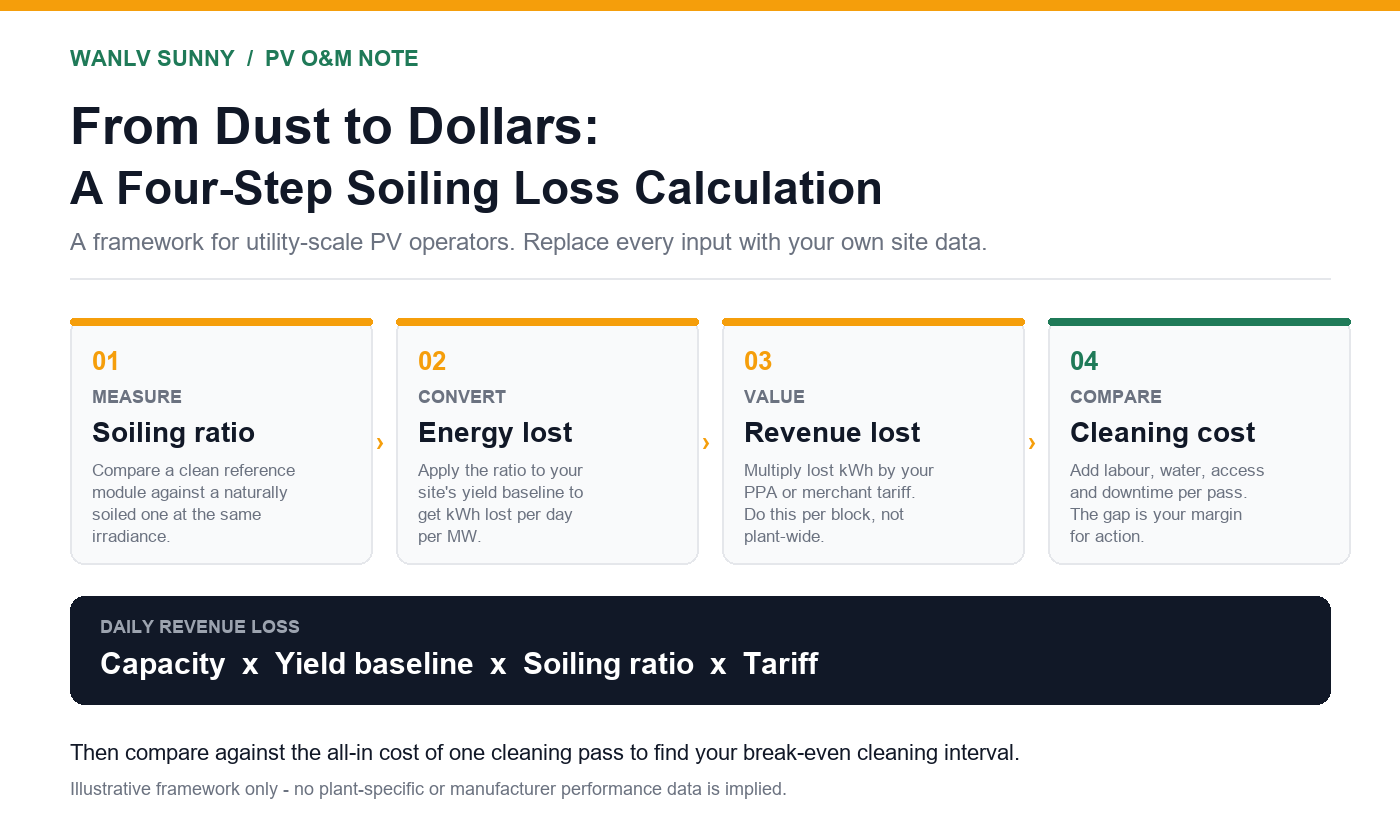
Capital cost is the visible part. The larger number is usually the accumulated cost of cleaning cycles: crew hours, water, transport, brush and battery replacement, and the output lost while modules are dirty. Our soiling loss cost calculator turns the loss side of that equation into a four-step method you can run with your own generation data; the companion comparison of robot and manual cleaning costs looks at the spend side. Run both before choosing an architecture – in a low-soiling, low-tariff market the most automated machine can have the longest payback.
Where to start
If you are at the beginning of an evaluation, the fastest route is to send your array geometry and cleaning frequency and ask for a shortlist rather than a single quote. Our cleaning robot range covers the tracked, ground-mobile straddle, fixed and aerial families described above, and the equipment shop lists the brushes and accessories that support them. We would rather rule out a machine that does not fit your site than sell one that will sit in a container.
Source: WANLV SUNNY | Wuxi Wanlv Intelligent Technology Co., Ltd.
Talk to a specialist
Tell us your plant size, row layout, module coating and cleaning frequency. We will come back with a shortlist and the specs that matter for your site.
Vicky | vicky@wanlvsunny.com | WhatsApp +86 181 1576 1000
Ziggy | ziggy@wanlvsunny.com | WhatsApp +86 181 5152 7178